Showing posts with label Cloud Computing. Show all posts

Wednesday, 10 August 2016

AWS Services


AWS Services

There are around 60 services provided by AWS. Some of the services which are best apt for companies with basic requirements are –
Instance (Compute)
Storage (EBS / S3)
Data warehouse (RDS / Redshift)
Application services


EC2 (A Virtual server in cloud) 

-  EC2 is a web-based virtual server for running  application programs. 
  
-    Comes with resizable computing capacity where we  can decide the computing power of our instances. For  ex, Number of CPU cores  and amount of memory. 

-      Billed for number of instances and number of hours


-   Instance level storage is local storage on the machine which disappears when the machine is shut down. Any data on that storage is lost.

-   EBS storage is persistent, so even when machine is shut down.

Amazon EBS

-    Amazon EBS (Elastic Block Store) provides block level  storage volumes where we can attach our EC2 instance.

-    Suitable for installing and running applications

-  EBS acts as a primary storage device for data that requires frequent and granular updates

-  EBS doesn’t work standalone. However it will work along with EC2 instance


S3 (Simple Storage Service)

-  A web service interface with fully redundant data  storage infrastructure to store and retrieve any amount  of data at any time and from anywhere on the web.

-   Data are stored in bucket form in which we can create any number of buckets in a block

-   S3 has a dual nature where it can work standalone or mount with an instance

-  Paramount advantage of S3 is, durability and availability where the data is stored at relatively low cost and replicated to avoid the risk of data loss


Amazon RDS (Relational Database Service)

-   Amazon RDS is a web-service which is used to set up, operate and scale a relational database in cloud.

Supports MySQL, MS SQL, Oracle, PostgreSQL databases

-   Despite its low cost advantage, it has a disadvantage of file size limitation based on certain region


Amazon Redshift

-  AWS provides fully managed data warehouse        (relational database) services.

-   AWS handles huge databases in petabytes range for  relatively low price

-    Provides NoSQL database

-   To improve querying performance, extra clusters can   be added with Redshift

-   Notable disadvantage is limited replication and limited snapshots
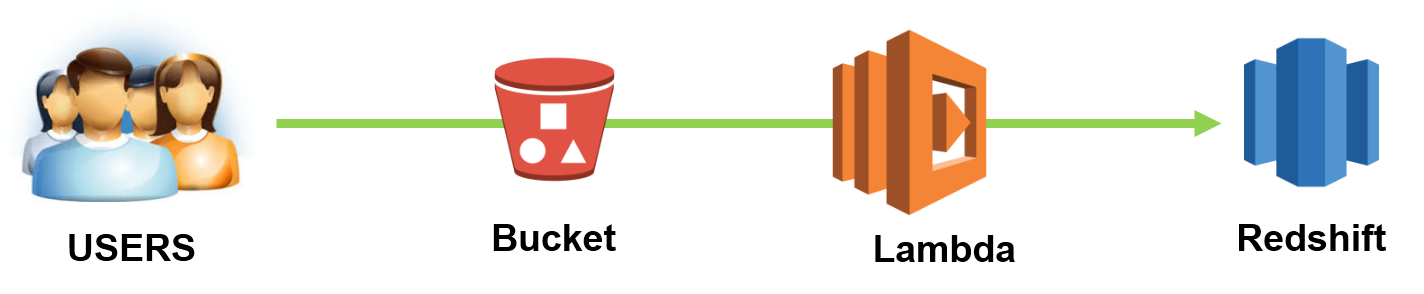
Amazon VPC (Virtual Private Cloud)

-  Lets us to setup a private cloud (isolated) within the Amazon Web Services

-  Privileged to have entire control over virtual network including own IP range, creation of subnets , configuration of route tables and network gateways

- Provides advanced high network security to enable inbound and outbound filtering at instance level and subnet level 

Thanks to all who visit this blog. 


Monday, 8 August 2016

An outline of Cloud computing


Cloud computing enables organizations to obtain flexible, secure, and cost-effective IT infrastructure.
Infrastructure can have virtual servers, databases, storage, messaging etc.
Cloud computing allows us to access servers, storage, databases and other applications over the internet. The two basic characteristics of cloud computing are virtualization and automation. Here, virtual means not physical i.e. CPU, disk, RAM, network cards are virtualized. Therefore, we don’t need to invest a large amount in buying and maintaining expensive hardware. Some of the key players who provide cloud services are

Service Providers - Platforms
AMAZON.COM – AWS (Amazon Web Services)
Microsoft – Azure
Google – Google App Engine
IBM – Blue cloud
Salesforce.com – Force.com

Amazon Web Services (AWS)
            AWS is a cloud computing platform provided by Amazon.com. Here, the web services refer to the cloud services or remote computing services where we can rent virtual computers on Amazon’s own infrastructure. It offers great value proposition. We pay for what we use.
            Dynamically scalable and virtualized resources are provided as a services over the internet. Advantages of going to cloud technology include cost savings, high availability and easy scalability.
Cloud computing provides shared resources on the internet in a scalable and simple way. The major advantage over mainframe is, the cloud computing offers infinite power and capacity.

IaaS
AWS provides a category of cloud services known as IaaS (Infrastructure as a Service) where it offers virtualized computing resources over the internet. IaaS provides access to networking features, virtual computers or dedicated hardware and data storage space. These virtualized computers come with guaranteed processing power and reserved bandwidth for storage and internet access.

Cloud computing challenges
Performance
Users from long distances may experience high latency and delays
Security and Privacy
Risk of vulnerability to attacks when information and critical IT resources are outside the firewall
Control
Cloud computing providers have a full control of the platforms and there is no platforms specific for companies and their business practices.
Bandwidth costs
Companies can save a lot of bucks on hardware and software; however, they have to incur higher network bandwidth charges particularly for high data intensive applications

Services provided by the AWS
            There are around 60 services provided by AWS where they can be accessed via the AWS management console (a web portal) or programmatically via API (or web services).
Some of the services being used across the industries are,
Compute
Storage
 Database
Network and CDN
Analytics
Application Services

Deployment and Management

                                                    Thanks for visiting.